If what you’re building isn’t an extension of you, why even bother?
For the past few years, I’ve kept building things. Most of them failed, at least if the measurement is revenue. But a lot of what I built, designed, or spent way too much time thinking about helped me get jobs or meet people I admire. A win is a win.
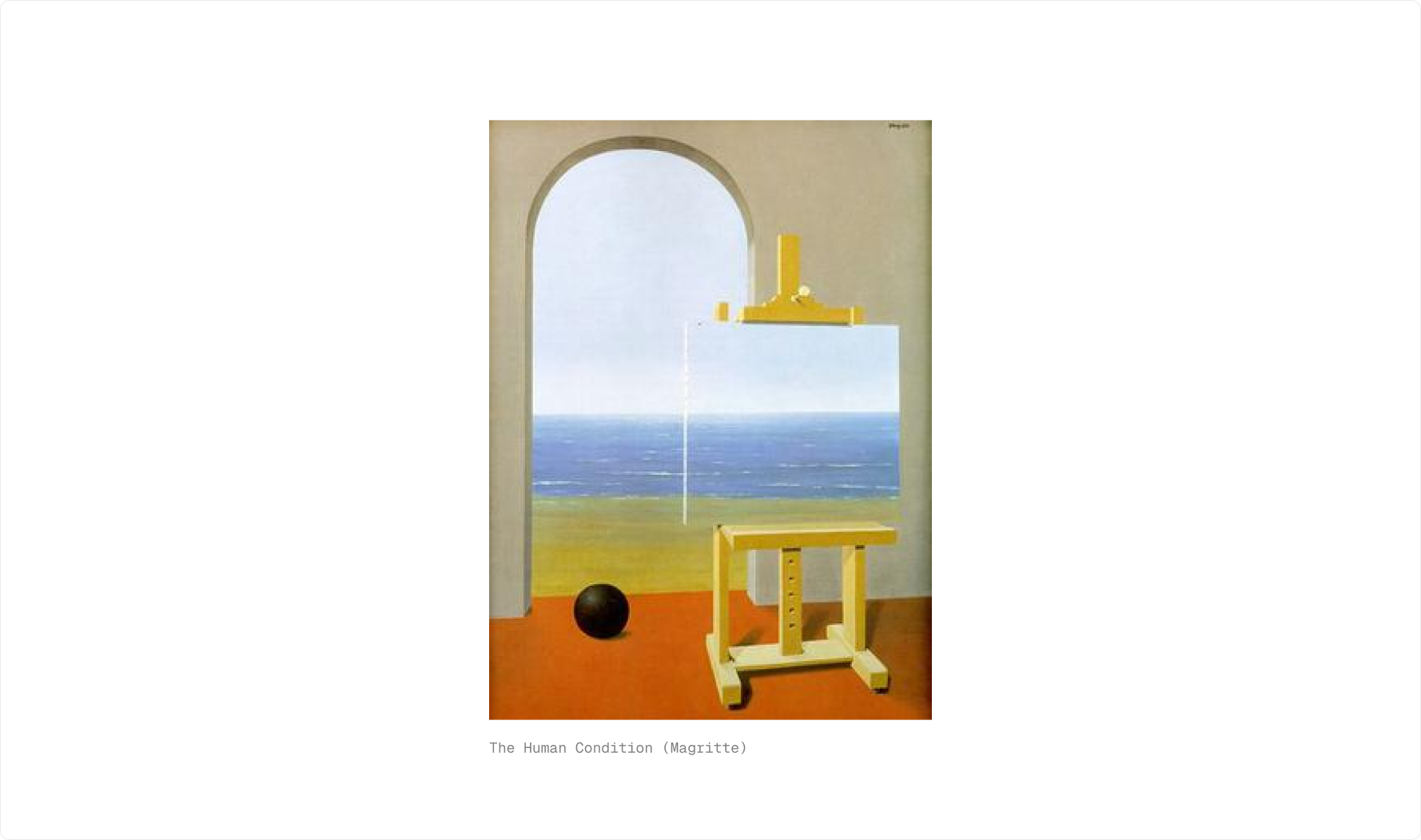
The Human Condition (Magritte)
Now that I’m reflecting on all of it, I’ve started to think it’s hard to build something great without doing the most important work alongside it: building you. Of course, random luck can push something you made into becoming a win. That happens. But luck is not really something you can build a life around.
So how do you build you, exactly?
This is one of those questions that makes you feel stuck the second you ask it. Where do you even start? And what does building yourself mean, anyway? I don’t think it means fixing every flaw or turning yourself into some perfectly optimized human. It means understanding yourself well enough to see what is moving you.
Back in SF, I had a conversation with a friend while we were walking. He said a lot of interesting things about this. I don’t remember his exact words, and I’ve probably rebuilt parts of the conversation in my head since then, but this is what stayed with me.
Before you can build yourself, you need to understand yourself, really understand yourself. To do that, you have to ask the questions you’re not ready to ask yet. You have to go deep, very, very deep, into every freaking corner of who you are.
One useful way to map that is through three things: people, events, and places. The people who loved you, ignored you, believed in you, disappointed you, challenged you, or made you feel seen. Not only family or close friends; sometimes one small interaction with someone you barely knew stays with you for years.
The events you expected and the ones you didn’t. The obvious milestones, but also the small moments you thought you had forgotten: a conversation that changed how you saw yourself, a rejection that made you work harder, a random opportunity that showed you a completely different life.
And then there are places. The place you come from, the places you’ve lived in, the country, the city, the street, the house, and even your own room. The scale can go from being a person on Earth all the way down to the corner of a room where you spent most of your childhood. Every scale leaves something in you.
And, funny enough, that walk in SF is already all three at once: a person, a place, and an event. It left me with a question I’m still trying to understand. These people, events, and places don’t just become memories. They leave behind habits, fears, tastes, beliefs, and definitions of what a good life is supposed to look like.
Sometimes, they also leave open loops.
An open loop is anything unfinished that keeps asking for some amount of your attention. Sometimes it’s extremely small: taking out the trash, cleaning your room, answering an email. The task itself takes five minutes, but you’ve spent three days remembering that you still haven’t done it.
Other loops are heavier: a message you’re avoiding, a promise you made, a conversation you keep replaying, an apology you never gave, a decision you refuse to make, or a version of yourself you still feel the need to prove. These are the same kind of problem, and they can’t be closed in the same way. But they do share one thing: they keep running quietly in the back of your mind.
One unfinished chore might take almost nothing from you, but pile up enough open loops and it becomes harder to hear yourself think.
That was the part that clicked for me. If your attention is constantly being pulled toward things you refuse to name, how much of it is left for understanding yourself? And if you don’t understand what is driving you, what exactly is driving the thing you’re building? So the goal isn’t to close every loop; that’s probably impossible.
The goal is to map them.
Start with a blank page and divide it into people, events, and places. Don’t list only the dramatic ones; include the things that seem too small to matter. Then ask:
- What did this give me?
- What did it make me believe?
- What am I still carrying from it?
- Is anything here unfinished?
Not every person, event, or place will contain an open loop. Some simply became part of you. For the ones that did leave something unfinished, ask what the next honest move is.
- Some loops need an action.
- Some need a conversation.
- Some need acceptance.
- Some may never close neatly. Maybe the work is simply choosing to carry them consciously instead of pretending they aren’t there.
Then make another small inventory.
- What do I know because I’ve lived it?
- What can I do because I’ve practiced it?
- What do I believe even when nobody is asking me to explain it?
This isn’t a résumé exercise. Don’t write what sounds impressive. Write what is actually true.
The overlap between what shaped you, what you can do, and what you cannot.